 Ελληνικά
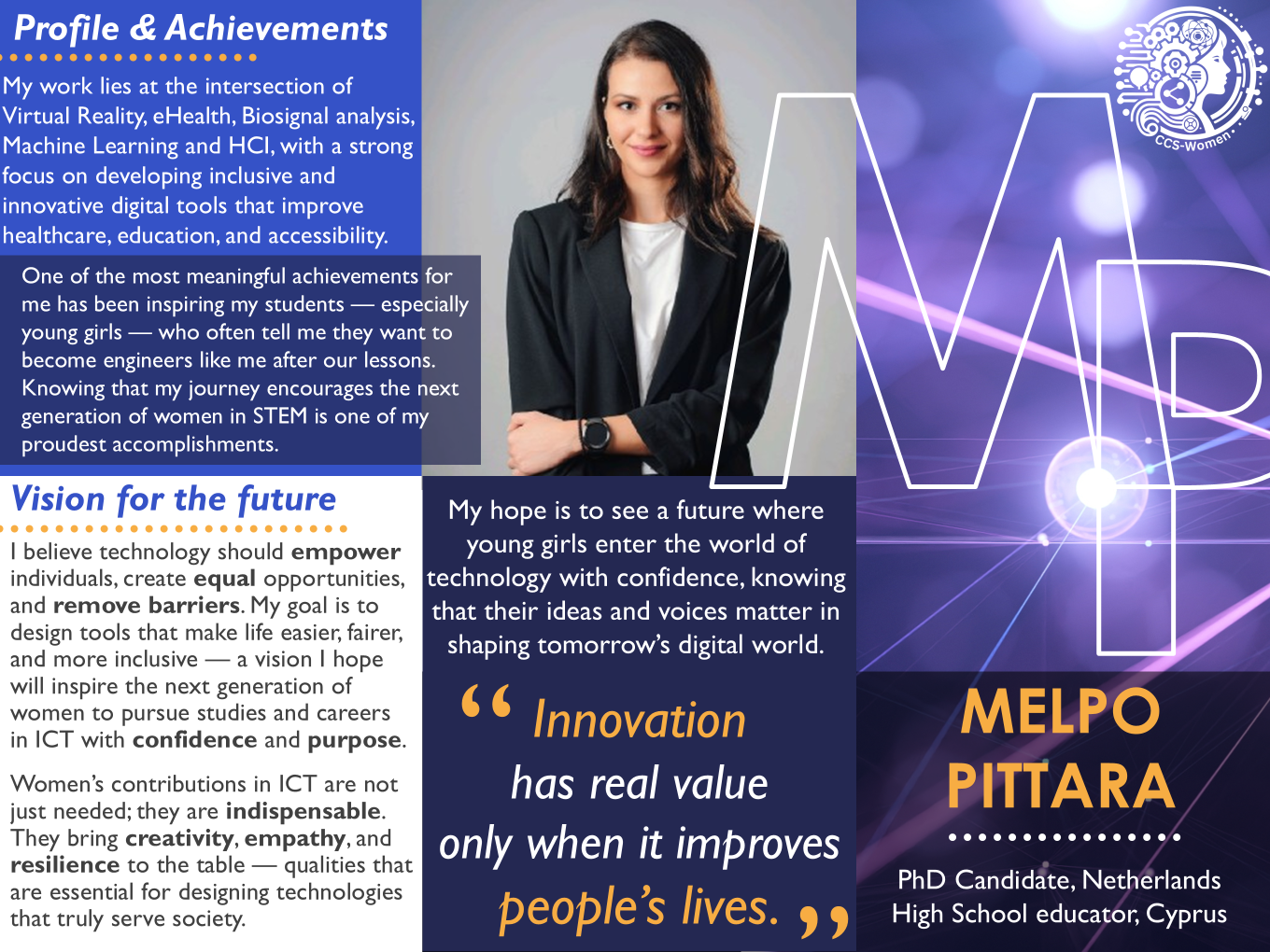
Read Melpo's inspiring story below!
Expertise
What is your role, job title, and field of expertise?
I am Melpo Pittara and I am a PhD candidate at the Bernoulli Institute for Mathematics, Computer Science and Artificial Intelligence of the University of Groningen in Netherlands, and I also teach the Design & Technology lesson at the high-school level. My work lies at the intersection of Virtual Reality, eHealth, Biosignal analysis, Machine Learning and Human–Computer Interaction, with a strong focus on developing inclusive and innovative digital tools that improve healthcare, education, and accessibility. By combining academic research with practical teaching, I aim to inspire the next generation while contributing to technological solutions that make a real impact.
Inspiration
What sparked your interest in this technology field and what path led you here?
From an early age, I was more interested in playing with LEGO than with dolls — always curious about how things were built and how they worked. That curiosity evolved into a passion for using technology to improve people’s lives. My studies in biomedical engineering gave me the foundation to explore how sensors, data, and algorithms could translate human physiology into actionable insights. This path naturally led me to virtual reality and interactive systems — tools that can reshape healthcare, education, and accessibility.
Career Growth
What skills and strategies have helped you succeed in tech?
Curiosity, resilience, and continuous learning have been my strongest tools. I combined engineering skills with programming, data analysis, and design thinking, which helped me collaborate across disciplines — from medical doctors to computer scientists. I also believe in community engagement and mentoring, which opened opportunities beyond research labs.
Memorable Achievements
Share a project or moment that reflects the impact of your work.
I had the privilege of participating in numerous international conferences around the world, where I shared my research and connected with experts across disciplines from my early steps in academia. Beyond academia, one of the most meaningful achievements for me has been inspiring my students — especially young girls — who often tell me they want to become engineers like you after our lessons. Knowing that my journey encourages the next generation of women in STEM is one of my proudest accomplishments.
Challenges
How do you stay ahead in a competitive field, and what obstacles have you overcome?
Staying in a fast-moving field means constantly upskilling — from learning new programming languages and mastering new research tools, to staying up to date with emerging areas like AI, data privacy. As a woman in tech, I have also faced stereotypes and moments where I needed to prove my expertise more than others. Instead of letting these experiences hold me back, I turned them into motivation: I became actively involved in mentoring students, giving talks, and contributing to diversity and inclusion initiatives.
Work-Life Balance
How do you manage the demands of career and personal life?
I see balance as a dynamic process. Prioritizing, setting boundaries, and keeping time for creative hobbies help me recharge. My health journey has also taught me that self-care and compassion are essential for long-term success.
Personal motive
What’s your motto?
“Innovation has real value only when it improves people’s lives.”
I believe technology should empower individuals, create equal opportunities, and remove barriers. My goal is to design tools that make life easier, fairer, and more inclusive — a vision I hope will inspire the next generation of women to pursue studies and careers in ICT with confidence and purpose.
Future
How do you envision the future of technology and what role can gender diversity and inclusion play?
I envision a future where health, education, and accessibility are seamlessly integrated with technology, creating systems that are not only smart but also compassionate and inclusive. Technology should adapt to people, not the other way around — ensuring that everyone, regardless of gender, background, or ability, can benefit from innovation. To achieve this, gender diversity and inclusion are vital: when women and men contribute equally, we combine different perspectives, leading to better solutions, fairer systems, and more meaningful progress. Women’s contributions in ICT are not just needed; they are indispensable. They bring creativity, empathy, and resilience to the table — qualities that are essential for designing technologies that truly serve society. My hope is to see a future where young girls enter the world of technology with confidence, knowing that their ideas and voices matter in shaping tomorrow’s digital world.