 Ελληνικά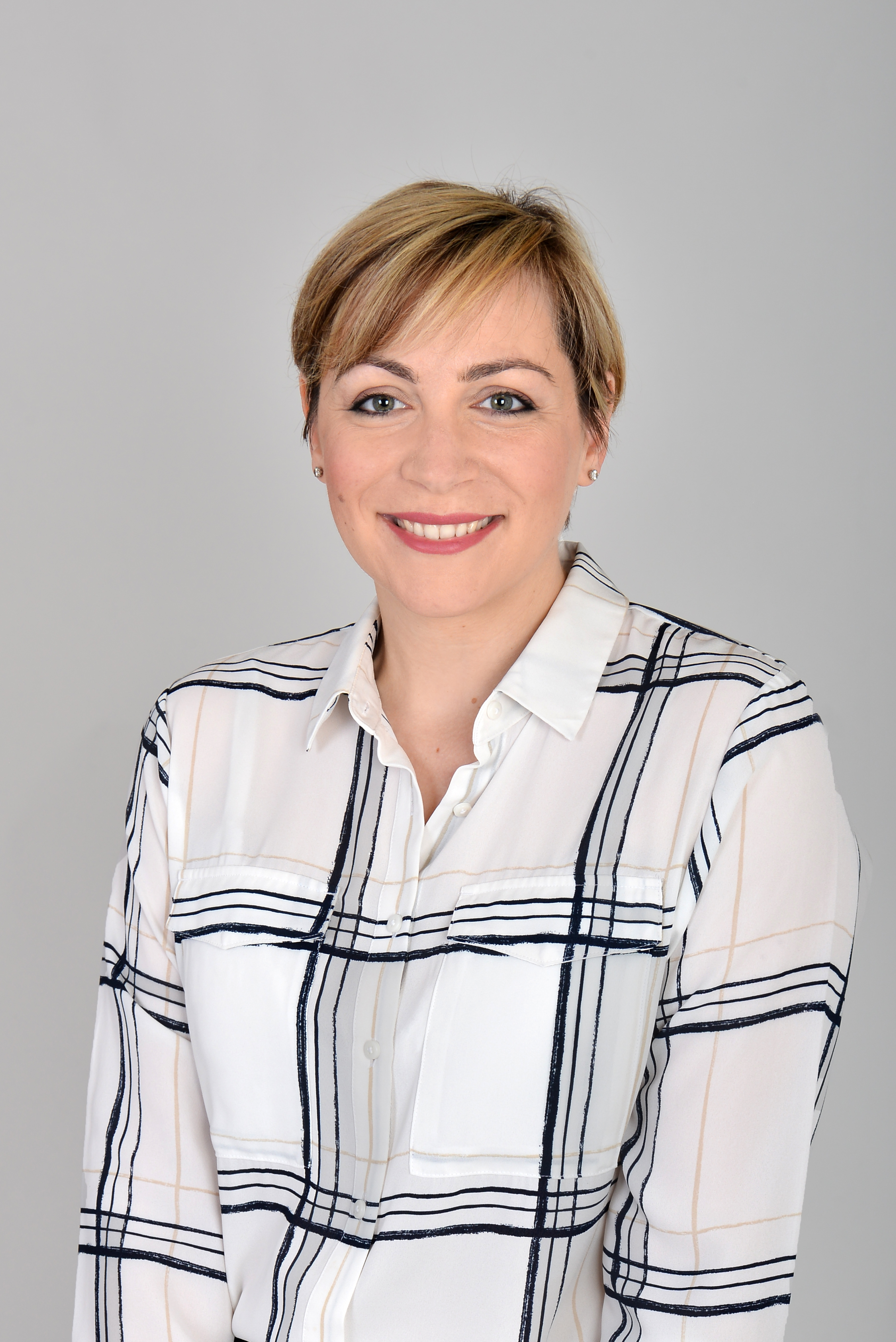
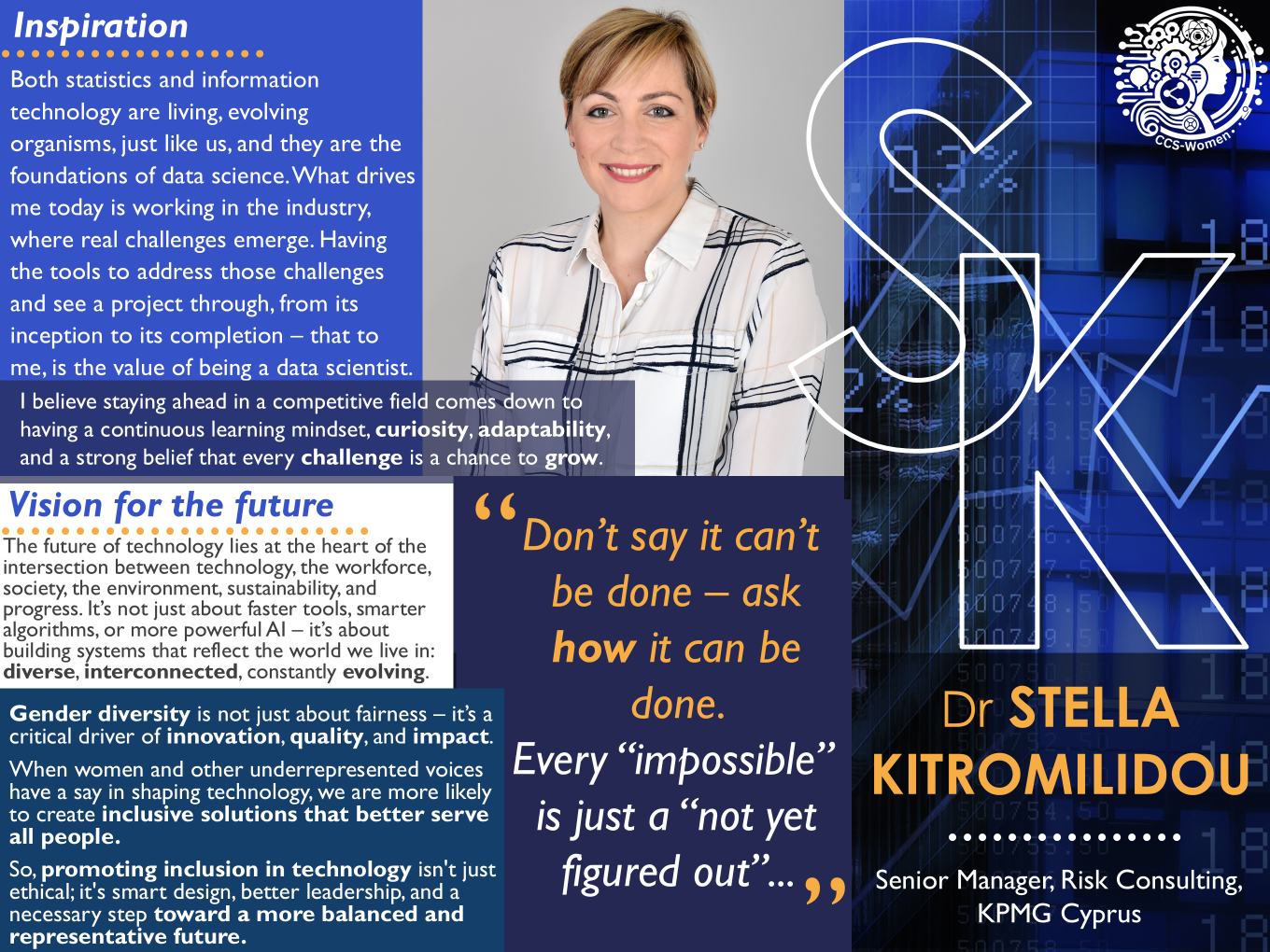
Read Stella's inspiring story below!
Expertise
What is your role, job title, and field of expertise?
I am Dr. Stella Kitromilidou, Senior Manager, Risk Consultant at KPMG Cyprus. My field of expertise is in Data Science, Computational Statistics.
Inspiration
What sparked your interest in this technology field and what path led you here?
As a statistician, I’ve always been fascinated by what conclusions and insights may come out of data when you ask the right questions. But during my early university years, I often felt a small step behind. I kept wondering, “Okay, but how will I actually do that?”
I was learning so much – statistical methods, modelling, hypothesis testing – but something felt incomplete. Then a brilliant professor introduced us to coding and showed us how we can do more with data and apply all those statistical concepts that we were learning, but up to then were theoretical. Statistics became truly alive for me at that very moment.
That was the starting point for me – my Point Zero – and the beginning of an exciting journey. Programming languages became tools in my hands, helping me uncover answers and build solutions. Both statistics and information technology are living, evolving organisms, just like us, and they are the foundations of data science. What drives me today is working in the industry, where real challenges emerge. Having the tools to address those challenges and see a project through, from its inception to its completion – that to me, is the value of being a data scientist.
Career Growth
What skills and strategies have helped you succeed in this field?
I would say it’s a combination of technical and soft skills. Analytical thinking, technical competence, coding in multiple languages, and curiosity are fundamental. To be good at what you do, you first need to know what you ‘re doing. But as I mentioned earlier, this field evolves quickly – staying open, hands-on, and willing to adapt is essential if you want to make a meaningful impact. You also need to love the process. You need to want to be challenged – because you will be challenged. You will get stuck. You will get frustrated. Things won’t work. But that’s part of the work. Curiosity and persistence are what keep you going and turn a problem into a puzzle worth solving.
Working in the industry has taught me that technical skills alone are not enough. To quote the well-known African proverb: “If you want to go fast, go alone. If you want to go far, go together” – well, it’s true. We work in teams, often with people from multidisciplinary backgrounds. Strong communication skills are crucial – not just for efficient collaboration and trust within the team, but also for bridging the gap with clients, who are often not technical. Being able to listen, understand their needs, communicate results clearly and simply, and tell the story behind the numbers – that’s what makes our work truly valuable.
Memorable Achievements
Share a project or moment that reflects the impact of your work.
The project that has most profoundly shaped both my career and personal journey was my involvement in supporting Eurostat on methodological work and statistical analysis of the second wave of the European Health Interview Survey (EHIS). As part of this project, I had the opportunity to work directly at Eurostat's premises in Luxembourg, in a secure environment due to the highly sensitive and confidential nature of the data. As a statistician, working with Eurostat was a dream come true — a moment of professional validation and excitement. Moreover, the project was extremely interesting and technically demanding. Before even accessing the data, we had to ensure that the appropriate statistical methodologies were selected and correctly implemented. Knowing we would be working onsite with no margin for delays, we had to prepare meticulously: creating dummy data, design appropriate models, anticipating edge cases, and simulating potential issues in advance. And still, despite all the preparation, we did encounter unexpected challenges. It was a powerful lesson in preparation, resilience and adaptability, and an experience I still draw from today.
Challenges
How do you stay ahead in a competitive field, and what obstacles have you overcome?
I have come to find that staying ahead in a fast-evolving field like data science a continuous learning mindset is essential. New tools, techniques, and expectations are constantly emerging. I try to stay curious, keep my skills sharp, and seek out opportunities to learn something new, whether it’s through formal training, self-study, or hands-on experience.
One of the biggest challenges I faced early in my career in the industry was to navigate uncertainty. I remember struggling to understand why a method I applied didn’t always produce the outcome I was expecting! But real-world projects don’t always go as planned – data are messy, requirements change, and solutions are almost never one-size-fits-all. Over time, with experience, I learned to embrace this complexity instead, and treat these challenges as building blocks to grow and improve.
Ultimately, I believe staying ahead in a competitive field comes down to having a continuous learning mindset, curiosity, adaptability, and a strong belief that every challenge is a chance to grow.
Work-Life Balance
How do you manage the demands of career and personal life?
I am pretty sure I don’t. I don’t believe in the concept of work-life balance as a perfectly even scale. To me, work life and personal life are not two ends that must always be in equilibrium. Sometimes the scale tips towards work, and other times it tips towards personal life – but we shouldn’t let it stay on one side for too long.
We are multidimensional beings with personal needs and aspirations, and on top of that I am also a woman, and a mother. And as a woman and a mother, I believe that it’s less about achieving perfect balance and more about being present where you are and being kind to yourself in the process. There are times when work demands more of me, and others when my family needs to come first.
I have an 11-year-old daughter, and I’m sure I’ve missed moments of her growing up that I can never get back. But whenever it truly mattered, when something was important, I believe I was there.
What’s helped me most is setting clear priorities, boundaries where possible, and staying flexible. I’ve also learned to honestly ask for help and lean on my support system – something that we should normalize and talk about more often. I also consider myself lucky to work in an environment having a leader who sees and supports me not only as a professional, but also as a mother – this makes a huge difference. That kind of trust, flexibility and understanding, for me, is what allows people to bring their whole creative selves to work. It’s important to be in a work environment where you feel seen, respected, and empowered to do your best without having to choose between your career and your family. This kind of culture isn’t just good for individuals; it’s good for teams and for business, too.
I believe being a dedicated professional and a present mother are not mutually exclusive. In fact, I believe they fuel each other. My work gives me purpose and pride, and my family gives me strength, perspective and responsibility. I want my child, my daughter, to grow up seeing, knowing that it’s possible for a woman to build a meaningful career without losing sight of who she is or what matters most.
Personal motive
What’s your personal moto or favourite quote that can also inspire the younger generation to follow studies and a career in an ICT field?
Don’t say it can’t be done – ask how it can be done. Every “impossible” is just a “not yet figured out”.
In the world of data, technology, and innovation, frustration isn’t failure – it’s a natural part of the process. Every challenge is an invitation to think differently. Curiosity, persistence, and creativity are what move us forward.
Future
How do you envision the future of technology and what role can gender diversity and inclusion play?
In my view, the future of technology lies at the heart of the intersection between technology, the workforce, society, the environment, sustainability, and progress. It’s not just about faster tools, smarter algorithms, or more powerful AI – it’s about building systems that reflect the world we live in: diverse, interconnected, constantly evolving. Technology is already embedded in nearly every aspect of life, and the decisions we make today, the tools we design, shape real experiences and outcomes for people, future generations, and the planet. So, for technology to serve everyone, the people who design, build, and lead it must also reflect that diversity.
Statistics related to gender diversity, however, especially in STEM fields, are still overwhelmingly disappointing. Women are under-represented in the total STEM workforce. They constitute less than a third of the total employment in STEM occupations (28.2% in 2024), while they are almost half of the total employment in non-STEM occupations (47.3% in 2024); they hold a fourth of non-STEM leadership roles (VP and C-suite positions), but only over one tenth in STEM. (Global Gender Gap Report for 2024, World Economic Forum)
Study after study in latest years highlight the benefits of gender equality, not only for women, but for the society and the economy in general. Gender equality boosts economic growth, economic stability and resilience; organizations with more women on their boards significantly outperform those without; organizations with more gender diversity in senior positions are more profitable; companies with diverse teams are 25% more likely to achieve increased profitability, etc. A diverse workforce is an innovative workforce, and that’s because often men and women, because of their diverse life experiences, bring different perspectives and ideas.
Therefore, gender diversity is not just about fairness – it’s a critical driver of innovation, quality, and impact. When women and other underrepresented voices have a say in shaping technology, we are more likely to create inclusive solutions that better serve all people. So, promoting inclusion in technology isn't just ethical; it's smart design, better leadership, and a necessary step toward a more balanced and representative future.
I believe that to build a better future for the next generations, we need everyone in the room — not just as participants, but as leaders, creators, and decision-makers. Inclusion fuels innovation, and innovation shapes the future.