 Ελληνικά
Read Ace's inspiring story below!
Expertise
What is your role, job title, and field of expertise?
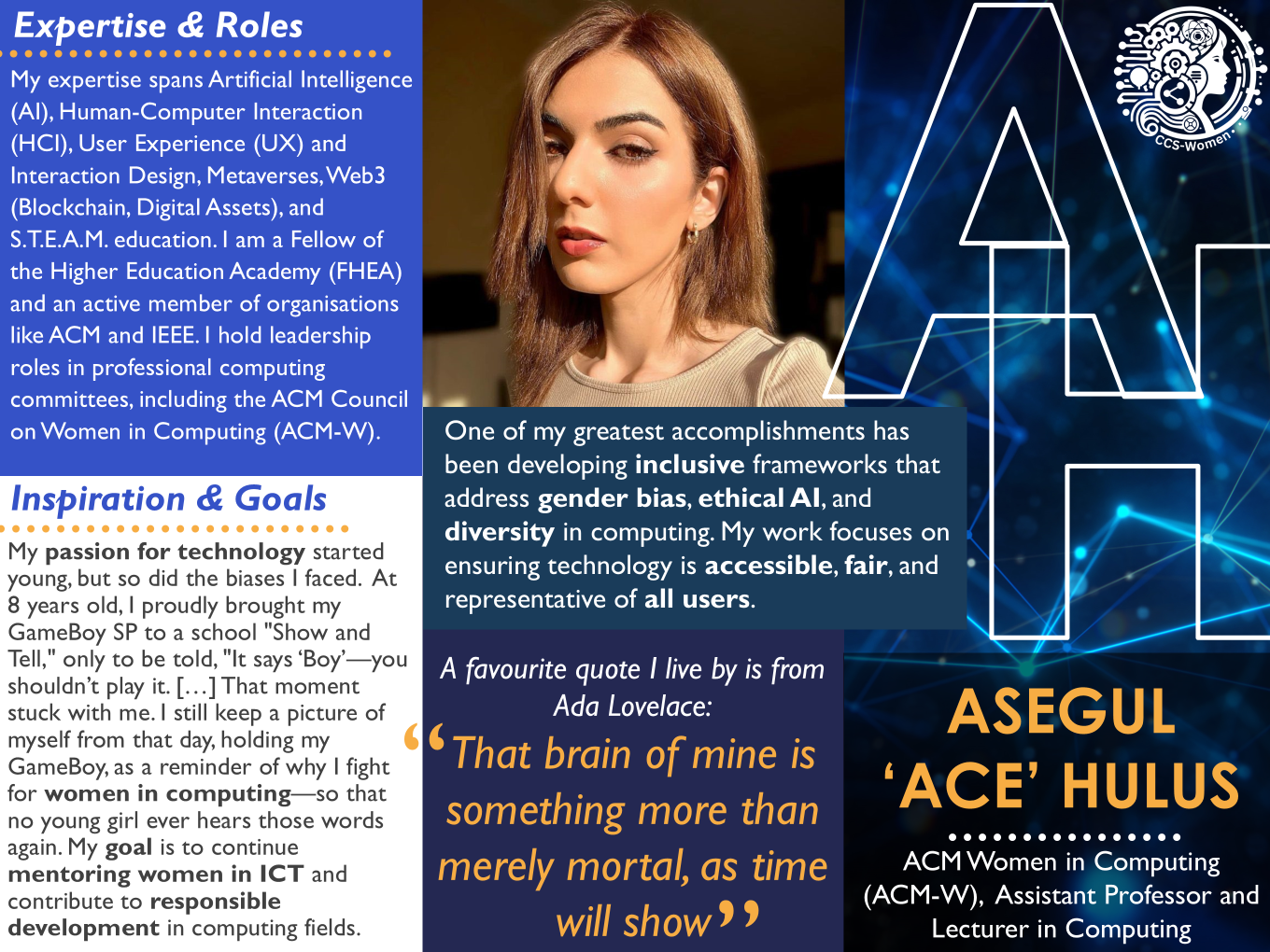
I am Dr. Asegul "Ace" Hulus, an Assistant Professor and Lecturer in Computing. My expertise spans Artificial Intelligence (AI), Human-Computer Interaction (HCI), User Experience (UX) and Interaction Design, Metaverses, Web3 (Blockchain, Digital Assets), and S.T.E.A.M. education. I am a Fellow of the Higher Education Academy (FHEA) and an active member of organisations like ACM and IEEE. Additionally, I hold leadership roles in professional computing committees, including the ACM Council on Women in Computing (ACM-W).
Inspiration
What sparked your interest in this technology field and what path led you here?
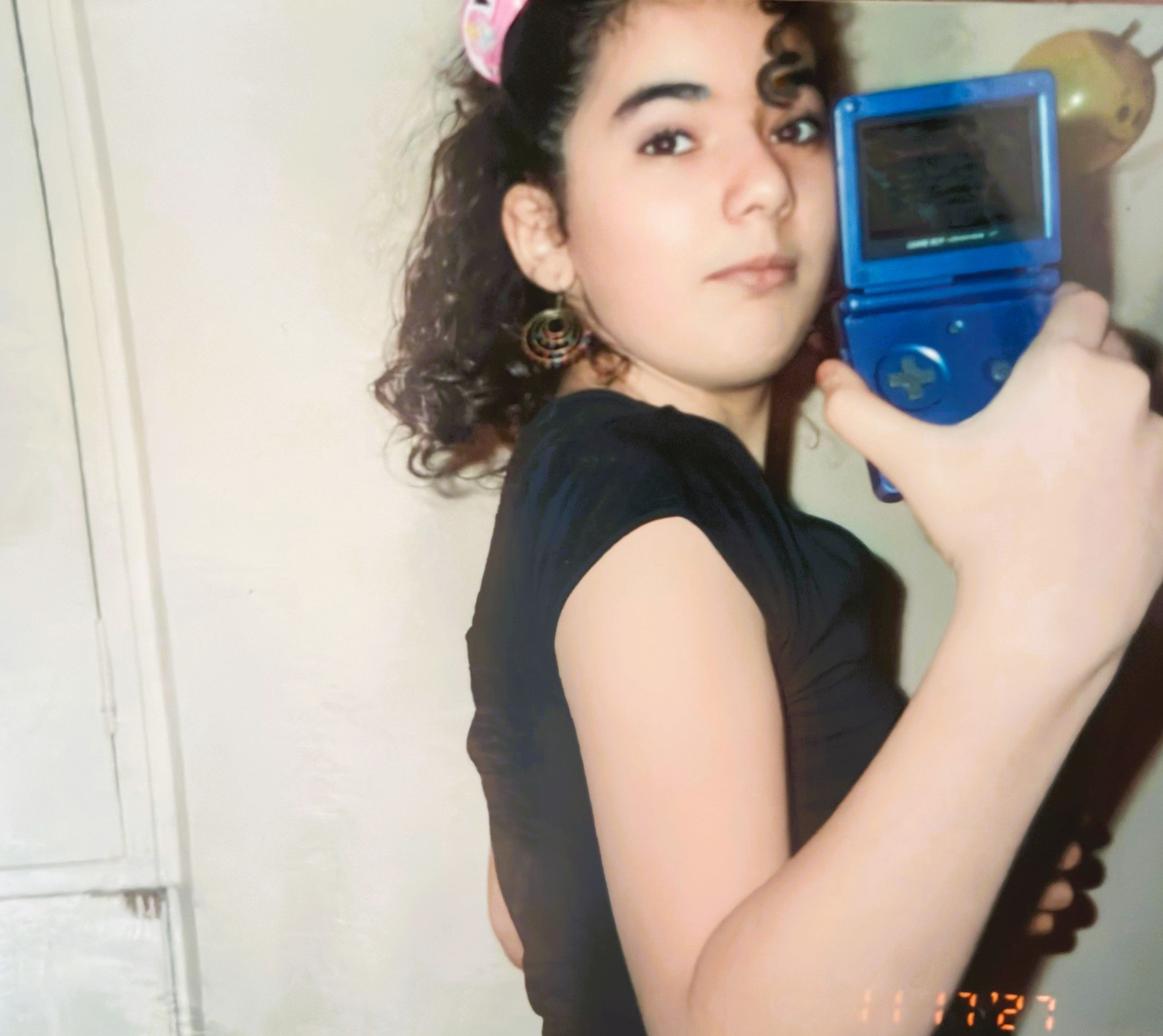
My passion for technology started young, but so did the biases I faced. At 8 years old, I proudly brought my GameBoy SP to a school "Show and Tell," only to be told, "It says ‘Boy’—you shouldn’t play it." Some even joked, "Maybe you were meant to be a boy." That moment stuck with me. I still keep a picture of myself from that day, holding my GameBoy, as a reminder of why I fight for women in computing—so that no young girl ever hears those words again.
This is the picture
Career Growth
What skills and strategies have helped you succeed in this field?
The key skills that have propelled my career include critical thinking, adaptability, and interdisciplinary research. Mastering HCI, AI development, and user experience principles has been crucial—yet, the sustainability of these topics, especially in terms of gender-based bias, remains a significant gap.
I have also focused on mentorship and leadership, particularly in women’s empowerment in tech. Staying ahead requires continuous learning, whether through peer-reviewed research, conferences, or hands-on computing projects.
A little background—I was initially forced to study English Language Teaching because I would have been the first woman in the computing department, and they feared I would "distract" the men. So, I ran back to London, earned a second master’s (MPhil) in computing, a PhD in computing, and even pursued a post-doc in computing. No distractions here—just determination and success.
Memorable Achievements
Share a project or moment that reflects the impact of your work.
One of my greatest accomplishments has been developing inclusive frameworks that address gender bias, ethical AI, and diversity in computing. My work focuses on ensuring technology is accessible, fair, and representative of all users.
A perfect example of this is my E-Ethical Learning concept. When I first introduced it, I was told it was "silly" because " I am a women who is a rebel, trying to undermine what men have done." Instead of backing down, I submitted it to ACM’s E-Learning Magazine, and within less than a year, it became the most-read article on their website. This experience reinforced my belief that ideas dismissed today can become innovations tomorrow—and that inclusivity in tech is not optional, but essential.
Challenges
How do you stay ahead in a competitive field, and what obstacles have you overcome?
As noted above, gender bias in tech started for me at a young age—and it still persists today. I’ve faced underlying biases like "You're not a normal girl." But what does it even mean to be "normal"? I want to flip the script on that outdated idea.
Through my scientific research, ACM-W leadership, and outspoken articles, I work to ensure that no young girl in computing ever doubts her place in this field because of stereotypes. One of my most impactful pieces, "You’re Not Like Other Girls": Examining Hidden Biases Women in STEAM Encounter, for the SEDA Blog, sparked a strong reaction, especially among men who hadn’t realized their unintentional biases. These conversations are exactly why I keep writing—because change begins with awareness.
Work-Life Balance
How do you manage the demands of career and personal life?
Balancing academia, research, and personal life is challenging, but I manage it by prioritizing tasks, setting boundaries, and incorporating wellness activities like gaming, going to the gym, digital arts, and community engagement. My passion for my work keeps me motivated, but I also ensure I set aside time for creativity and relaxation, knowing that balance fuels both productivity and innovation.
And remember—the world did not burn because you chose to prioritize your mental health. We are women, we find the strength! But our greatest strength is our well-being.
Personal motive
What’s your personal motto or favourite quote that can also inspire the younger generation to follow studies and a career in an ICT field?
A favourite quote I live by is from Ada Lovelace: "That brain of mine is something more than merely mortal, as time will show”. This reminds me that us women, we are special, and we can do anything, as long as we put our mind to out. Everyone has a unique brain, as Ada Lovelace put it. The power is in you to find your path.
Future
How do you envision the future of technology and what role can gender diversity and inclusion play?
The future of technology will be deeply intertwined with AI, blockchain, and extended reality (XR). Gender diversity and inclusion will fuel innovation—different perspectives challenge biases in computing fields and lead to more ethical, inclusive tech solutions. My goal is to continue mentoring women in ICT and contribute to responsible development in computing fields.